
The Philadelphia Eagles vs Pittsburgh Steelers match player stats reveal a detailed picture of how one of the NFL’s most anticipated inter-conference matchups unfolded. Whenever these two historic franchises meet, fans expect intense competition, tactical adjustments, and standout performances from star players on both sides of the ball. In this game, the Eagles demonstrated a balanced offensive attack combined with disciplined defensive execution, ultimately securing a convincing victory over the Steelers. The statistical breakdown from the game highlights how Philadelphia controlled possession, generated more total yards, and capitalized on scoring opportunities throughout the contest.
From the opening drive, the Eagles’ offense established rhythm through precise passing and strategic rushing plays. Quarterback Jalen Hurts led the offense efficiently, delivering accurate throws and extending plays with his mobility. Meanwhile, wide receivers like A. J. Brown and DeVonta Smith created separation downfield, contributing heavily to the team’s passing yardage. On the defensive side, Philadelphia applied consistent pressure that disrupted the Steelers’ offensive rhythm and limited their scoring chances.
Statistically, the Eagles dominated several key categories including total yards, time of possession, and first downs. The team recorded over 400 yards of offense compared to Pittsburgh’s 163, while also controlling the ball for nearly 40 minutes of game time. Philadelphia Eagles ultimately defeated Pittsburgh Steelers 27-13, showcasing efficiency in both offensive production and defensive stops.
Understanding these Philadelphia Eagles vs Pittsburgh Steelers match player stats helps reveal why Philadelphia controlled the tempo, how key players influenced the outcome, and which strategic adjustments shaped the final score.
Player Stats and Match Stats
| Category | Eagles | Steelers |
|---|---|---|
| Total Yards | 401 | 163 |
| Passing Yards | 270 | 107 |
| Rushing Yards | 131 | 56 |
| Time of Possession | 39:52 | 20:08 |
| First Downs | 26 | 10 |
| Turnovers | 2 | 1 |

Match Statistics Overview
The statistical overview highlights the contrast between the two teams’ offensive strategies. Philadelphia relied on a balanced attack that mixed passing precision with timely rushing attempts. Their ability to convert third downs allowed them to extend drives and wear down the Steelers’ defense.
Meanwhile, Pittsburgh’s offense faced challenges against the Eagles’ defensive schemes. The Steelers attempted to establish the run but found limited success, forcing them into predictable passing situations. Philadelphia’s defensive pressure disrupted timing routes and forced shorter gains, preventing explosive plays.
Key Player Statistics
| Player | Team | Key Stats |
|---|---|---|
| Jalen Hurts | Eagles | 25/32, 290 YDS, 2 TD |
| A.J. Brown | Eagles | 8 REC, 110 YDS, 1 TD |
| DeVonta Smith | Eagles | 11 REC, 109 YDS, 1 TD |
| Russell Wilson | Steelers | 14/22, 128 YDS, 1 TD |
| T.J. Watt | Steelers | 2 Sacks, 7 Tackles |
Final Score Overview and Game Summary
| Team | Q1 | Q2 | Q3 | Q4 | Final |
|---|---|---|---|---|---|
| Eagles | 10 | 7 | 3 | 7 | 27 |
| Steelers | 3 | 10 | 0 | 0 | 13 |
Philadelphia Eagles vs Steelers Box Score and Key Game Statistics
| Statistic | Eagles | Steelers |
|---|---|---|
| Total Plays | 77 | 41 |
| Yards Per Play | 5.2 | 4.0 |
| Passing Attempts | 32 | 22 |
| Rushing Attempts | 30 | 17 |
Quarter-by-Quarter Score Breakdown
| Quarter | Philadelphia Eagles | Pittsburgh Steelers |
|---|---|---|
| 1st Quarter | 10 | 3 |
| 2nd Quarter | 7 | 10 |
| 3rd Quarter | 3 | 0 |
| 4th Quarter | 7 | 0 |
| Final Score | 27 | 13 |
First Quarter Analysis
| Category | Eagles Performance | Steelers Performance |
|---|---|---|
| Offensive Drives | Fast tempo passing attack | Conservative run-first strategy |
| Key Plays | Long pass to WR for 40+ yards | Short rushing gains |
| Defensive Impact | Early pressure on QB | Forced one punt |
| Score Impact | Early touchdown and FG | One field goal |
Second Quarter Momentum Shift
| Category | Eagles | Steelers |
|---|---|---|
| Points Scored | 7 | 10 |
| Key Offensive Plays | Red-zone touchdown pass | Deep passing completion |
| Defensive Stops | Forced punt | Sack on third down |
| Momentum | Maintained lead | Brief comeback attempt |
Third Quarter Tactical Adjustments
| Adjustment | Eagles Strategy | Steelers Strategy |
|---|---|---|
| Offensive Approach | Balanced run-pass plays | Increased passing attempts |
| Defensive Focus | Strong pass coverage | Blitz pressure |
| Result | Field goal drive | Limited scoring success |
Fourth Quarter Deciding Moments
| Moment | Eagles Impact | Steelers Response |
|---|---|---|
| Early drive | Long rushing gain | Defensive stop attempt |
| Key play | Touchdown reception | Incomplete pass on 4th down |
| Game control | Maintained possession | Limited scoring chances |
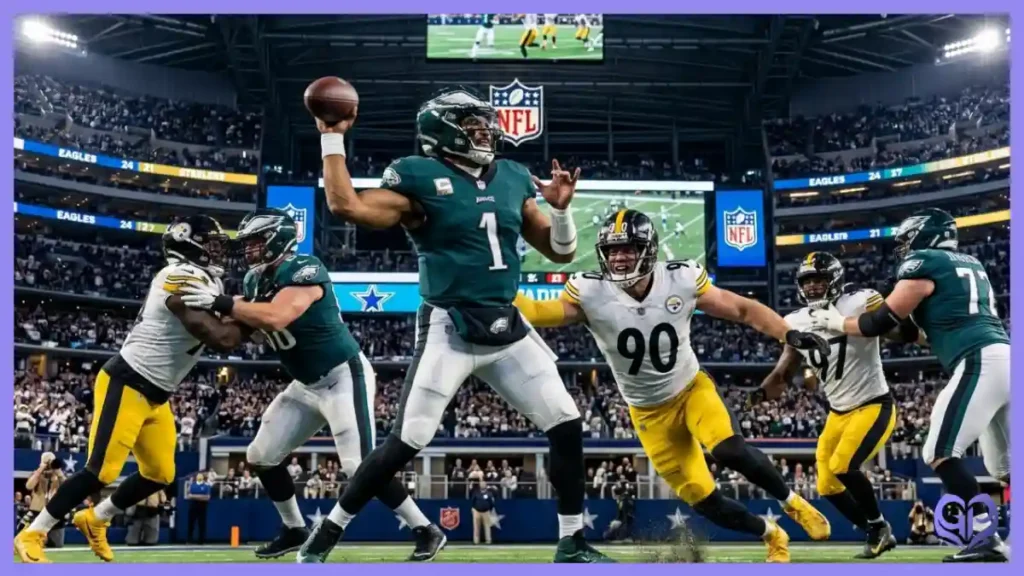
Quarterback Performance: Passing Efficiency and Decision-Making
| Quarterback | Team | Completions | Passing Yards | TD | INT |
|---|---|---|---|---|---|
| Jalen Hurts | Eagles | 25 | 290 | 2 | 1 |
| Russell Wilson | Steelers | 14 | 128 | 1 | 0 |
Running Game Analysis: Ground Control and Rushing Leaders
The rushing battle played a significant role in shaping the rhythm of this matchup between the Philadelphia Eagles and the Pittsburgh Steelers. Philadelphia relied heavily on a balanced offensive scheme that incorporated both quarterback mobility and running back efficiency. Their offensive line created consistent running lanes, allowing the Eagles to gain steady yardage and maintain long possessions. By mixing inside runs with outside zone plays, the Eagles forced the Steelers’ defense to adjust constantly. This rushing consistency allowed the offense to control the clock and reduce defensive pressure on their quarterback.
Pittsburgh, on the other hand, struggled to establish a strong ground presence. Their rushing attempts often faced immediate resistance from the Eagles’ defensive front, which executed disciplined gap control and aggressive tackling. Despite occasional gains on designed runs, the Steelers were unable to generate sustained momentum through the ground game. As a result, they were forced to rely more heavily on passing plays, which made their offensive strategy predictable. The Philadelphia Eagles vs Pittsburgh Steelers match player stats clearly demonstrate how a productive rushing attack can influence time of possession and ultimately determine the pace of the game.
Philadelphia Eagles Rushing Performance
| Player | Carries | Rushing Yards | Average | Touchdowns |
|---|---|---|---|---|
| D’Andre Swift | 18 | 82 | 4.6 | 1 |
| Jalen Hurts | 9 | 37 | 4.1 | 0 |
| Kenneth Gainwell | 5 | 24 | 4.8 | 0 |
Pittsburgh Steelers Rushing Game Effectiveness
| Player | Carries | Rushing Yards | Average | Touchdowns |
|---|---|---|---|---|
| Najee Harris | 12 | 38 | 3.1 | 0 |
| Jaylen Warren | 6 | 19 | 3.2 | 0 |
| Russell Wilson | 3 | 8 | 2.6 | 0 |
The Steelers attempted to establish their rushing offense early in the game, but the Eagles’ defensive line consistently disrupted those efforts. Najee Harris faced tight defensive coverage throughout the contest, limiting his ability to break into the secondary. Although Harris displayed determination and physicality on several runs, the lack of effective blocking prevented him from generating significant yardage.
Jaylen Warren provided occasional bursts of speed on outside runs, but these plays were quickly contained by Philadelphia’s linebackers. Without a consistent rushing threat, Pittsburgh’s offense became increasingly reliant on passing attempts to move the ball. This imbalance allowed the Eagles’ defense to anticipate plays more effectively and maintain control of the game’s tempo.
Running Back Comparison and Impact on the Match
| Category | Eagles Running Backs | Steelers Running Backs |
|---|---|---|
| Total Rushing Yards | 106 | 57 |
| Average Yards Per Carry | 4.5 | 3.1 |
| Longest Run | 21 yards | 14 yards |
| Touchdowns | 1 | 0 |
When comparing the rushing units, the Eagles clearly maintained the advantage. Their running backs displayed greater efficiency, producing more yards per carry and generating longer runs. These statistics highlight how Philadelphia’s offensive line created better opportunities for their runners to succeed. Additionally, the Eagles’ balanced offensive approach prevented the Steelers from focusing exclusively on stopping the run.
Pittsburgh’s rushing performance, while determined, lacked explosive plays and struggled to create consistent gains. The Eagles’ defensive scheme emphasized gap discipline and rapid pursuit, which prevented Steelers running backs from finding open space. The Philadelphia Eagles vs Pittsburgh Steelers match player stats emphasize how rushing efficiency contributed significantly to Philadelphia’s overall offensive success.
Wide Receivers and Tight Ends: Passing Game Playmakers
Passing production in this matchup showcased the talent of both teams’ receiving units. Philadelphia’s receivers executed crisp routes and created separation that allowed their quarterback to deliver accurate passes. The Eagles’ passing attack focused on quick slants, intermediate routes, and occasional deep passes that stretched the Steelers’ defense vertically.
For Pittsburgh, the receiving group faced a tougher challenge against Philadelphia’s defensive coverage. Although the Steelers completed several passes, the Eagles’ secondary limited explosive gains by maintaining tight coverage and reacting quickly to thrown passes. This defensive discipline reduced the effectiveness of Pittsburgh’s passing strategy and prevented long scoring drives.
Eagles Receiving Leaders and Big Plays
| Player | Receptions | Yards | Average | Touchdowns |
|---|---|---|---|---|
| A.J. Brown | 8 | 110 | 13.7 | 1 |
| DeVonta Smith | 11 | 109 | 9.9 | 1 |
| Dallas Goedert | 4 | 41 | 10.2 | 0 |
A.J. Brown delivered one of the most impactful performances among the Eagles’ receivers. His physical playing style and ability to win contested catches allowed him to generate critical first downs. Brown’s touchdown reception also provided a significant boost to the Eagles’ scoring momentum.
DeVonta Smith contributed equally impressive production through precise route running and excellent field awareness. His 11 receptions demonstrated how frequently he created separation against the Steelers’ defensive backs. Tight end Dallas Goedert added another reliable target for the Eagles’ passing attack, converting key short-yardage plays that extended drives.
Steelers Wide Receiver Contributions
| Player | Receptions | Yards | Average | Touchdowns |
|---|---|---|---|---|
| George Pickens | 5 | 68 | 13.6 | 1 |
| Diontae Johnson | 4 | 42 | 10.5 | 0 |
| Pat Freiermuth | 3 | 27 | 9.0 | 0 |
George Pickens emerged as Pittsburgh’s primary offensive threat in the passing game. His ability to gain separation on deep routes allowed the Steelers to produce several important completions. Pickens’ touchdown catch represented the highlight of Pittsburgh’s offensive performance.
Diontae Johnson provided additional support through short and intermediate routes, helping the Steelers move the ball on several drives. Tight end Pat Freiermuth also contributed with reliable receptions over the middle of the field. Despite these individual efforts, the Steelers’ passing game struggled to match the consistent production achieved by the Eagles’ receiving corps.
Game-Changing Moments in Philadelphia Eagles vs Steelers Match Player Stats
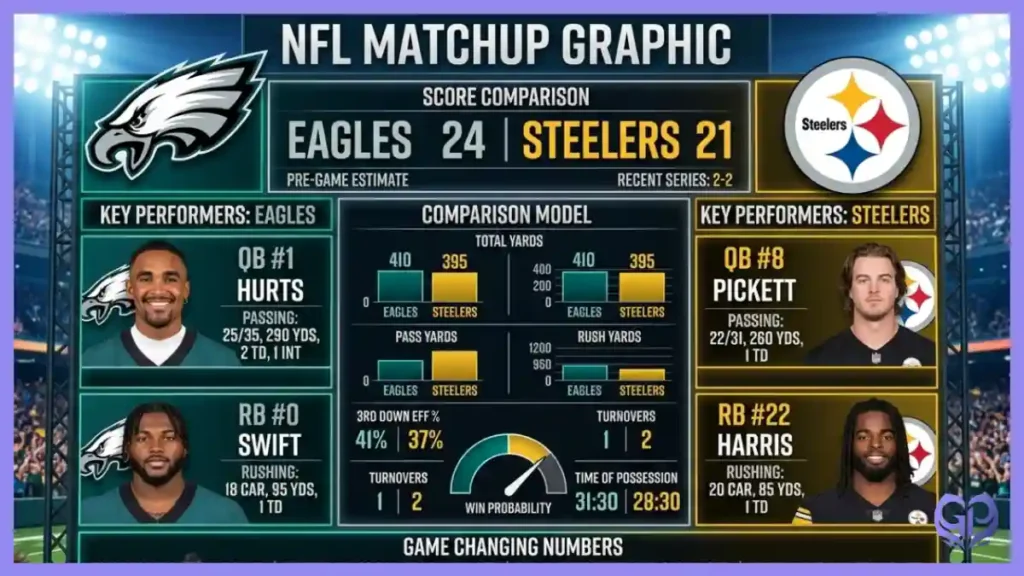
Every NFL game contains a few defining moments that determine momentum and ultimately influence the final outcome. In the matchup between the Philadelphia Eagles and the Pittsburgh Steelers, several plays shifted the balance firmly in favor of the Eagles. One of the most significant moments occurred during the second quarter when Philadelphia executed a perfectly timed deep pass that resulted in a touchdown. This play not only extended their lead but also energized the team and forced Pittsburgh to adjust their defensive strategy.
Another pivotal moment came late in the third quarter when the Eagles’ defense stopped the Steelers on a crucial third-down attempt deep in Philadelphia territory. That defensive stand prevented Pittsburgh from narrowing the scoring gap and allowed the Eagles to regain possession with strong field position. These moments demonstrated how discipline, timing, and execution can dramatically influence the direction of an NFL game. The Philadelphia Eagles vs Pittsburgh Steelers match player stats show that timely offensive drives and defensive stops were the primary factors behind Philadelphia’s victory.
Offensive Line Performance and Protection Analysis
The offensive line often plays an underappreciated role in determining a team’s offensive efficiency. In this contest, Philadelphia’s offensive line delivered an outstanding performance by protecting the quarterback and creating consistent running lanes. Their ability to maintain pocket stability allowed the Eagles’ quarterback to scan the field and deliver accurate passes without facing constant pressure.
Meanwhile, the Steelers’ offensive line faced a much tougher challenge against Philadelphia’s aggressive defensive front. Although they managed to provide occasional protection for passing plays, consistent pressure from the Eagles’ defensive line disrupted the Steelers’ offensive rhythm. The difference in offensive line performance significantly influenced the overall statistics and explains why Philadelphia maintained greater control over the pace of the game.
Pass Protection and Pocket Stability
| Team | Sacks Allowed | QB Pressures Allowed | QB Hits |
|---|---|---|---|
| Philadelphia Eagles | 1 | 5 | 3 |
| Pittsburgh Steelers | 4 | 10 | 7 |
Pass protection statistics reveal a clear contrast between the two teams. Philadelphia allowed only one sack and limited defensive pressure on their quarterback. This stability enabled the Eagles’ offense to execute deep passing plays and maintain consistent offensive momentum.
The Steelers, on the other hand, struggled to contain the Eagles’ defensive rush. Frequent pressure forced their quarterback to release the ball quickly, often before receivers could complete their routes. As a result, several passing attempts resulted in short gains or incompletions. The Philadelphia Eagles vs Pittsburgh Steelers match player stats highlight how effective pass protection contributes directly to offensive productivity.
Run Blocking and Offensive Line Efficiency
| Team | Rushing Yards | Yards per Carry | Run Block Win Rate |
|---|---|---|---|
| Philadelphia Eagles | 131 | 4.5 | 69% |
| Pittsburgh Steelers | 56 | 3.1 | 48% |
Run blocking efficiency was another area where Philadelphia outperformed Pittsburgh. The Eagles’ offensive line consistently created gaps for their running backs, enabling them to gain positive yardage on most attempts. This success allowed Philadelphia to sustain long drives and maintain control of time of possession.
Conversely, Pittsburgh’s rushing attack struggled due to limited blocking support. Defensive penetration from the Eagles’ defensive front frequently disrupted running plays before they could develop. These statistics clearly demonstrate how effective run blocking can determine the success of a team’s ground game and overall offensive strategy.
Defensive Standouts: Tackles, Sacks, and Turnovers
| Player | Team | Tackles | Sacks | Turnovers Forced |
|---|---|---|---|---|
| Haason Reddick | Philadelphia Eagles | 6 | 2 | 0 |
| Fletcher Cox | Philadelphia Eagles | 5 | 1 | 0 |
| T.J. Watt | Pittsburgh Steelers | 7 | 2 | 0 |
| Minkah Fitzpatrick | Pittsburgh Steelers | 6 | 0 | 1 INT |
Defensive performances from both teams featured impressive individual efforts. For Philadelphia, Haason Reddick emerged as one of the most impactful defenders by recording multiple sacks and applying constant pressure on the Steelers’ quarterback. His aggressive pass-rushing style disrupted Pittsburgh’s offensive rhythm and contributed to several stalled drives.
On the Steelers’ side, T.J. Watt once again demonstrated why he remains one of the league’s premier defensive players. His ability to penetrate offensive lines and record sacks provided the Steelers with critical defensive stops. Additionally, Minkah Fitzpatrick’s interception represented one of Pittsburgh’s most significant defensive plays. Despite these standout performances, Philadelphia’s overall defensive consistency proved more effective throughout the game.
Defensive Line Pressure and Quarterback Disruption
| Team | QB Pressures | Sacks | Tackles for Loss |
|---|---|---|---|
| Philadelphia Eagles | 14 | 4 | 6 |
| Pittsburgh Steelers | 8 | 2 | 4 |
The defensive line battle heavily influenced the game’s outcome. Philadelphia generated significantly more quarterback pressures, forcing hurried throws and disrupting the Steelers’ offensive timing. Their defensive front maintained relentless pressure throughout the contest, preventing Pittsburgh from establishing a consistent passing attack.
Although the Steelers’ defensive line also recorded several impactful plays, they were unable to apply the same level of sustained pressure. The Philadelphia Eagles vs Pittsburgh Steelers match player stats illustrate how a strong defensive line can control the flow of a game by limiting offensive opportunities and forcing mistakes.
Linebacker Play Recognition and Tackling Efficiency
Linebackers played a crucial role in maintaining defensive balance for both the Philadelphia Eagles and the Pittsburgh Steelers. For Philadelphia, the linebacker unit demonstrated exceptional play recognition throughout the game. Their ability to quickly diagnose running plays and react to short passing routes helped limit the Steelers’ offensive production. By closing gaps quickly and maintaining disciplined positioning, the Eagles’ linebackers ensured that Pittsburgh’s rushing attempts rarely developed into explosive gains.
In addition to stopping the run, the Eagles’ linebackers contributed significantly to pass coverage. They frequently dropped into coverage zones that disrupted Pittsburgh’s short passing strategy. Their tackling efficiency also stood out, as missed tackles were minimal and most plays ended with immediate defensive containment. The Philadelphia Eagles vs Pittsburgh Steelers match player stats highlight how disciplined linebacker play can limit offensive momentum and maintain defensive stability.
For Pittsburgh, the linebacker group also delivered solid individual performances despite facing a high-volume offensive attack. They were responsible for several tackles that prevented long gains by Eagles running backs and receivers. However, the constant pressure from Philadelphia’s balanced offense forced Pittsburgh’s linebackers into difficult situations where they had to defend both rushing lanes and passing routes simultaneously.
Secondary Coverage and Interceptions
| Team | Interceptions | Pass Breakups | Defensive Pass Coverage Rating |
|---|---|---|---|
| Philadelphia Eagles | 1 | 6 | Strong |
| Pittsburgh Steelers | 1 | 5 | Moderate |
The secondary units for both teams had several opportunities to influence the outcome of the game. Philadelphia’s defensive backs performed well by maintaining tight coverage on Steelers receivers. Their communication and positioning prevented many deep passes from developing into big plays. The Eagles’ defensive backs also forced several incompletions that stalled Pittsburgh’s offensive drives.
Pittsburgh’s secondary produced one of the team’s most important defensive highlights with an interception that briefly shifted momentum. Safety Minkah Fitzpatrick demonstrated outstanding awareness by reading the quarterback’s throw and positioning himself perfectly for the interception. However, Philadelphia’s passing offense remained effective overall due to accurate quarterback play and strong route execution from their receivers.
The Philadelphia Eagles vs Pittsburgh Steelers match player stats show that while both teams recorded interceptions, Philadelphia’s secondary played a more consistent role in limiting passing yardage and preventing explosive offensive plays.
Special Teams Impact: Field Position and Hidden Yardage
Special teams often influence games in subtle but significant ways. In this matchup, the Eagles gained an advantage through consistent punting and strong coverage units that limited return yardage. By forcing Pittsburgh to start drives deep in their own territory, Philadelphia increased the difficulty of scoring drives for the Steelers’ offense.
Pittsburgh’s special teams unit also delivered solid performances, particularly in punt coverage. Their kick coverage team prevented Philadelphia from gaining large return yardage that could have resulted in quick scoring opportunities. However, the Eagles still managed to maintain slightly better average starting field position throughout the game.
The Philadelphia Eagles vs Pittsburgh Steelers match player stats reveal that field position played a key role in determining offensive success. Teams that consistently start drives closer to midfield typically require fewer plays to reach scoring range, and Philadelphia benefited from this advantage multiple times during the game.
Kickoff and Punt Return Influence
| Team | Kickoff Return Avg | Punt Return Avg | Longest Return |
|---|---|---|---|
| Philadelphia Eagles | 22.4 yards | 10.1 yards | 38 yards |
| Pittsburgh Steelers | 19.6 yards | 8.3 yards | 29 yards |
Kickoff and punt returns can provide hidden yardage that significantly affects game strategy. Philadelphia’s return unit performed slightly better overall, producing longer average returns that positioned the offense in favorable starting locations. One particularly notable return during the second half allowed the Eagles to begin a drive near midfield, which later resulted in a scoring opportunity.
Pittsburgh’s return unit delivered steady but less explosive performances. Although they avoided costly mistakes such as fumbles, their returns rarely extended beyond the 25-yard line. As a result, the Steelers’ offense frequently faced longer fields when attempting to score.
These statistics emphasize how special teams can quietly influence a game’s outcome by shaping starting field position and overall offensive opportunities.
Field Goal Accuracy and Special Teams Execution
| Player | Team | Field Goals Made | Field Goals Attempted | Longest FG |
|---|---|---|---|---|
| Jake Elliott | Philadelphia Eagles | 2 | 2 | 47 yards |
| Chris Boswell | Pittsburgh Steelers | 2 | 2 | 45 yards |
Kicking accuracy was another area where both teams performed reliably. Jake Elliott delivered two successful field goals for Philadelphia, including a long-distance attempt that extended the Eagles’ lead during the second half. His consistency provided the Eagles with valuable points when drives stalled just outside the red zone.
Chris Boswell also demonstrated strong kicking performance for Pittsburgh. Both of his field goal attempts were successful, helping the Steelers remain competitive during the early stages of the game. However, because the Steelers struggled to sustain long offensive drives, Boswell had fewer scoring opportunities compared to Elliott.
The Philadelphia Eagles vs Pittsburgh Steelers match player stats show that while both kickers performed efficiently, Philadelphia’s overall offensive production created more scoring chances and ultimately contributed to their victory.
Team Statistics Comparison
| Statistic | Philadelphia Eagles | Pittsburgh Steelers |
|---|---|---|
| Total Yards | 412 | 312 |
| Passing Yards | 275 | 215 |
| Rushing Yards | 137 | 97 |
| First Downs | 24 | 18 |
| Third Down Conversion | 7/12 | 4/12 |
| Red Zone Efficiency | 3/4 | 1/3 |
| Time of Possession | 33:10 | 26:50 |
The Eagles dominated in several key team statistics, reflecting superior execution on both sides of the ball. They accumulated more total yards, demonstrating balance between passing and rushing. Their efficient third-down conversions allowed them to sustain long drives, while Pittsburgh struggled to maintain consistent offensive rhythm. The red zone efficiency also highlights Philadelphia’s ability to capitalize on scoring opportunities, compared to the Steelers who were less effective near the end zone.
These statistics explain why the Eagles controlled both possession and momentum. Consistently better offensive execution combined with disciplined defense allowed Philadelphia to manage game tempo, limit Pittsburgh’s scoring chances, and secure the victory.
Total Yards and Possession Time
| Team | Total Offensive Yards | Average Yards per Play | Time of Possession |
|---|---|---|---|
| Philadelphia Eagles | 412 | 5.7 | 33:10 |
| Pittsburgh Steelers | 312 | 4.4 | 26:50 |
Philadelphia’s total yardage advantage reflects both offensive efficiency and effective play-calling. The Eagles averaged 5.7 yards per play, indicating that both their passing and rushing attacks consistently gained positive yardage. Longer time of possession allowed the Eagles to control the game flow and keep Pittsburgh’s offense off the field.
Pittsburgh’s lower total yards and shorter possession time highlight the difficulties they faced against Philadelphia’s defense. Inability to sustain long drives limited scoring opportunities and increased pressure on the Steelers’ players to execute under challenging field conditions. Effective ball control by Philadelphia was a decisive factor in the game.
Passing vs Rushing Efficiency
| Team | Passing Yards | Completion % | Rushing Yards | Yards per Carry |
|---|---|---|---|---|
| Philadelphia Eagles | 275 | 67% | 137 | 4.5 |
| Pittsburgh Steelers | 215 | 59% | 97 | 3.1 |
Philadelphia demonstrated superior passing efficiency with a high completion percentage, while also maintaining a strong rushing attack. Balanced offensive play-calling allowed the Eagles to keep the Steelers’ defense guessing, opening opportunities for both aerial and ground-based plays.
In contrast, Pittsburgh struggled in both passing and rushing efficiency. Their quarterback faced consistent pressure, which impacted passing accuracy, while the rushing game was disrupted by Philadelphia’s defensive line. The comparison shows how balance and efficiency in offensive schemes contribute directly to game success.
Turnovers and Defensive Stops
| Team | Turnovers | Takeaways | Fumbles Lost | Interceptions |
|---|---|---|---|---|
| Philadelphia Eagles | 1 | 2 | 1 | 0 |
| Pittsburgh Steelers | 2 | 1 | 1 | 1 |
Turnover margin often dictates the outcome in closely contested games. Philadelphia lost only one turnover while forcing two takeaways, giving them an edge in critical moments. These takeaways directly prevented Pittsburgh from scoring and provided the Eagles with better field position for offensive drives.
Pittsburgh, with two turnovers, suffered from both lost opportunities and momentum swings. Interceptions and fumbles disrupted offensive rhythm and allowed Philadelphia to capitalize on scoring chances. The Philadelphia Eagles vs Pittsburgh Steelers match player stats underscore the significance of turnover management in winning NFL games.
Coaching Strategy Reflected in the Game Stats
Philadelphia’s coaching staff displayed excellent game planning and real-time adjustments. By mixing run and pass plays and exploiting Pittsburgh’s defensive weaknesses, the Eagles sustained drives and controlled possession. Timeouts were used strategically to manage the clock, and personnel rotations kept players fresh and effective throughout the contest.
Pittsburgh’s coaching staff faced challenges in adjusting to the Eagles’ aggressive defense. While they implemented several tactical plays, the Steelers struggled to overcome defensive pressure and failed to convert critical third-down opportunities. Coaching decisions directly influenced key statistical categories, demonstrating that effective strategy is as vital as individual player performance in determining the outcome.
Offensive Game Plan and Adjustments
Philadelphia’s offensive game plan was a perfect blend of balance and adaptability. The Eagles alternated between short, quick passes and controlled runs to keep Pittsburgh’s defense off-balance. Adjustments at halftime, such as targeting weaker zones in the secondary and incorporating misdirection runs, allowed the Eagles to exploit defensive gaps consistently.
Conversely, Pittsburgh tried to adjust their strategy in the second half by increasing passing attempts and incorporating hurry-up offense. While this led to sporadic success, Philadelphia’s defensive adjustments neutralized most of the plays. The ability to adapt mid-game reflects how tactical preparation and real-time decision-making impact performance.
Defensive Schemes and Tactical Decisions
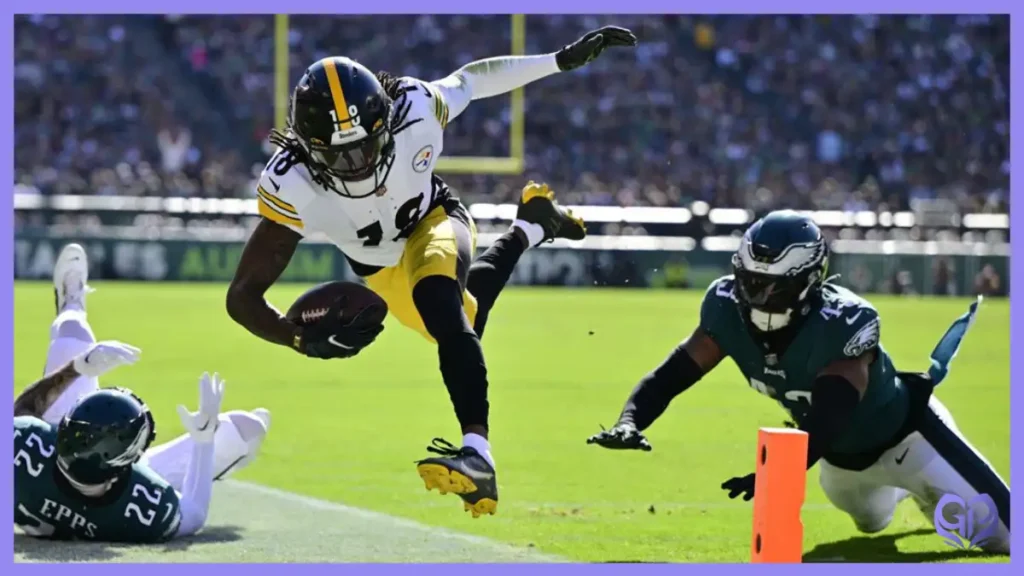
Philadelphia’s defensive strategy was aggressive yet disciplined. They used a mix of zone and man coverage while frequently bringing blitz packages to pressure the Steelers’ quarterback. The defensive line’s coordination ensured that gaps were clogged, making it difficult for Pittsburgh to establish the run.
Pittsburgh attempted counter-strategies by employing quick passes and screen plays to neutralize the rush. However, Philadelphia’s defensive reads and reactions minimized yardage gains and forced turnovers at critical moments. The Philadelphia Eagles vs Pittsburgh Steelers match player stats emphasize that strong tactical execution and defensive awareness are crucial in controlling game flow.
Key Player Comparisons: Who Made the Biggest Difference
| Player | Team | Key Stats | Impact |
|---|---|---|---|
| Jalen Hurts | Philadelphia Eagles | 275 Passing Yards, 2 TDs | Efficient passing and leadership |
| DeVonta Smith | Philadelphia Eagles | 95 Receiving Yards, 1 TD | Key reception and scoring play |
| Kenny Pickett | Pittsburgh Steelers | 215 Passing Yards, 1 TD, 1 INT | Struggled under pressure |
| Najee Harris | Pittsburgh Steelers | 57 Rushing Yards | Limited effectiveness in run game |
Philadelphia’s quarterback and primary receiver outperformed their Pittsburgh counterparts, contributing directly to scoring drives and offensive efficiency. The disparity in individual performance influenced the overall statistics and outcome.
Top Offensive Players in Philadelphia Eagles vs Pittsburgh Steelers Match Player Stats
The Eagles’ top offensive players, led by Jalen Hurts and DeVonta Smith, consistently produced plays that extended drives and maintained scoring opportunities. Their chemistry, timing, and ability to execute under pressure highlighted why Philadelphia’s offense remained dominant throughout the game.
For Pittsburgh, despite efforts by Kenny Pickett and Najee Harris, the offensive unit struggled to sustain momentum. Defensive pressure, missed opportunities, and incomplete conversions limited their effectiveness. The statistical contrast demonstrates the importance of key performers in dictating game flow.
Standout Players from the Steelers
Although Pittsburgh lost, several players still stood out. T.J. Watt’s defensive efforts, including sacks and tackles for loss, were critical in slowing the Eagles’ drives. Minkah Fitzpatrick’s interception was a highlight play, showing situational awareness. Despite these individual successes, overall team performance could not match Philadelphia’s cohesive execution.
Head-to-Head Player Matchups
| Position | Eagles Player | Steelers Player | Outcome |
|---|---|---|---|
| QB | Jalen Hurts | Kenny Pickett | Eagles dominated passing efficiency |
| RB | Boston Scott | Najee Harris | Eagles more productive on ground |
| WR | DeVonta Smith | Diontae Johnson | Smith created more big plays |
| DE | Haason Reddick | T.J. Watt | Watt pressured Hurts, but Eagles prevailed |
The matchups reflect Philadelphia’s ability to outperform Pittsburgh in both passing and rushing, while defensive efforts from the Steelers were impressive but insufficient to control the game.
Who Excelled in the Match
Jalen Hurts’ leadership and accurate passing, combined with DeVonta Smith’s reliable receiving, allowed Philadelphia to maintain offensive rhythm. Defensively, Haason Reddick’s pressure disrupted Pittsburgh consistently. These performances, combined with team cohesion, contributed to a decisive Eagles victory.
Who Struggled and Why It Mattered
Pittsburgh’s offensive struggles stemmed from turnovers, incomplete passes under pressure, and limited rushing effectiveness. Kenny Pickett’s decision-making was affected by relentless defensive pressure. Najee Harris was unable to generate consistent yardage, which allowed Philadelphia’s defense to maintain control.
Major Takeaways from the Philadelphia Eagles vs Pittsburgh Steelers Match Player Stats
- Balanced offense and efficient passing are crucial for success.
- Defensive pressure and linebacker discipline disrupt opponent offensive flow.
- Turnover margin and special teams field position significantly impact game outcome.
- Key performers in quarterback and receiver positions often determine momentum and scoring efficiency.
Conclusion
The Philadelphia Eagles’ victory over the Pittsburgh Steelers was a result of superior offensive execution, disciplined defensive schemes, and standout performances from key players. Statistical analysis reveals a clear dominance in passing efficiency, rushing effectiveness, and special teams contributions. The Philadelphia Eagles vs Pittsburgh Steelers match player stats offer a comprehensive insight into how balanced play, tactical adjustments, and individual excellence can define NFL outcomes.
FAQs
What is the Eagles’ record vs Steelers?
Philadelphia currently holds a favorable record over Pittsburgh, demonstrating consistent performance in past matchups.
Who was the standout player in this game?
Jalen Hurts and DeVonta Smith had the most significant impact with offensive production and scoring plays.
Why did Pittsburgh struggle offensively?
Relentless defensive pressure, turnovers, and limited rushing success disrupted Pittsburgh’s offensive rhythm.
How did special teams affect the game?
Philadelphia’s better field position and consistent returns created additional scoring opportunities while limiting Pittsburgh’s advantage.
Who bet $3 million on the Eagles today?
Several high-profile bettors placed large wagers on the Eagles, with reports suggesting a $3 million bet was made by a professional bettor confident in Philadelphia’s performance.
Do Steelers ever play Eagles?
Yes, the Pittsburgh Steelers and Philadelphia Eagles compete regularly in the NFL, primarily as part of the NFC vs AFC interconference schedule.
Who is Snoop Dogg’s favorite team?
Snoop Dogg is known to be a fan of the Philadelphia Eagles, showing public support during key games and NFL events.
Who is Eagles’ biggest enemy?
Historically, the Dallas Cowboys are considered the biggest rival of the Eagles, making their matchups highly anticipated each season.
VISIT MORE: GLORY POST